RiLiFi
Start free

Free list · Hard but fair · Every answer explained

Hard general knowledge questions

Here are 50 hard general knowledge questions with answers in five rounds, from world history to numbers. Each answer has a short line on why it is right, and every answer is checked against two sources. Run a round as a live quiz or print it.

Sample

Run as a live quiz

Who led the first voyage to sail from Europe to India around Africa?

Run a round as a live quiz with a leaderboard, free for 100 players.

More general knowledge quizzes

Run a hard general knowledge quiz live

Start from the ready-made 20-question hard quiz, or build your own from the questions on this page. Players join on their phones with a PIN or QR code, and the leaderboard goes up on the big screen.

How to run a hard general knowledge quiz

A hard round works best for regulars, quiz clubs and teams who found the mixed round too easy. Keep it fair: give teams time to talk, and read the reason after each answer so the room learns something.

  • Teams, not singles. Play in teams of three or four on one phone each. RiLiFi has no separate team mode, so one phone per team gives one score per team, and a table can work a hard question out together.
  • More time. Hard questions need thinking time. Raise the timer above the default 30 seconds when you make your copy of the quiz.
  • Speed bonus off. Switch the speed bonus off in the quiz settings so a careful right answer scores the same as a fast one. A wrong answer scores zero, because there is no negative marking.
  • Ties. On equal points the leaderboard ranks the faster team first, so there is always one winner.
All 50 hard general knowledge questions, with answers

Press Show answer under a question to see the answer and why it is right. These are difficult general knowledge questions, but each one is a settled fact a good team can work towards. The two sources for each answer are listed under its round.

Round 1: World history

  1. Who led the first voyage to sail from Europe to India around Africa?
    Show answer

    Vasco da Gama His fleet left Lisbon in 1497, rounded the Cape of Good Hope and reached Calicut (Kozhikode) in 1498.

    Run as a live quiz
  2. The ruins of ancient Carthage are in which modern country?
    Show answer

    Tunisia Carthage was founded by the Phoenicians, and its ruins stand on the coast near Tunis.

    Run as a live quiz
  3. Which Greek mathematician is known as the father of geometry?
    Show answer

    Euclid His Elements, written around 300 BCE, was used to teach geometry for more than 2,000 years.

    Run as a live quiz
  4. The Meiji Restoration of 1868 began the fast modernisation of which country?
    Show answer

    Japan In 1868 power passed back to the emperor, and Japan began to modernise its industry, schools and government.

    Run as a live quiz
  5. Which 1494 treaty divided newly reached lands between Spain and Portugal?
    Show answer

    The Treaty of Tordesillas It drew a line west of the Cape Verde islands: lands to the west went to Spain and to the east to Portugal, which is why Brazil speaks Portuguese.

    Run as a live quiz
  6. Which woman ruled ancient Egypt as pharaoh and built a great temple at Deir el-Bahari?
    Show answer

    Hatshepsut Hatshepsut ruled in the 1400s BCE, and her terraced temple stands on the west bank of the Nile at Luxor.

    Run as a live quiz
  7. Which king of the Franks was crowned emperor in Rome on Christmas Day in 800?
    Show answer

    Charlemagne Charlemagne ruled much of western Europe, from today’s France to Germany and northern Italy.

    Run as a live quiz
  8. Which city did Peter the Great found on the Baltic coast in 1703?
    Show answer

    Saint Petersburg It was Russia’s capital for about two centuries, until the government moved to Moscow in 1918.

    Run as a live quiz
  9. The Antikythera mechanism, found off a Greek island, was made to do what?
    Show answer

    Track the Sun, Moon and planets Its bronze gears worked like an early analogue computer for astronomy, more than 2,000 years ago.

    Run as a live quiz
  10. The stone city of Great Zimbabwe was built by ancestors of which people?
    Show answer

    The Shona Its great walls were built from granite blocks without mortar, between the 11th and 15th centuries.

    Run as a live quiz

Sources

  1. Vasco da GamaBritannica · Vasco da GamaWikipedia
  2. Archaeological Site of CarthageUNESCO · CarthageWikipedia
  3. EuclidBritannica · EuclidWikipedia
  4. Meiji RestorationBritannica · Meiji RestorationWikipedia
  5. Treaty of TordesillasBritannica · Treaty of TordesillasWikipedia
  6. HatshepsutBritannica · HatshepsutWikipedia
  7. CharlemagneBritannica · CharlemagneWikipedia
  8. St. PetersburgBritannica · Saint PetersburgWikipedia
  9. Antikythera mechanismBritannica · Antikythera mechanismWikipedia
  10. Great Zimbabwe National MonumentUNESCO · Great ZimbabweWikipedia

Round 2: Science and space

  1. What is the unit of electrical resistance?
    Show answer

    The ohm It is named after the German physicist Georg Ohm, and its symbol is the Greek letter omega, Ω.

    Run as a live quiz
  2. Which blood vessels carry blood away from the heart?
    Show answer

    Arteries Arteries have thick, stretchy walls for the pressure of each heartbeat. Veins carry blood back to the heart.

    Run as a live quiz
  3. What does DNA stand for?
    Show answer

    Deoxyribonucleic acid DNA carries the instructions for building living things, in the double helix shape described in 1953.

    Run as a live quiz
  4. Which force slows down two surfaces that rub against each other?
    Show answer

    Friction Friction turns some movement energy into heat, which is why rubbing your hands together warms them.

    Run as a live quiz
  5. Io, the most volcanically active world in the Solar System, is a moon of which planet?
    Show answer

    Jupiter Io has hundreds of volcanoes, and some throw lava fountains dozens of kilometres high.

    Run as a live quiz
  6. Which astronomer showed that planets travel around the Sun in ellipses, not circles?
    Show answer

    Johannes Kepler Kepler published his laws of planetary motion between 1609 and 1619.

    Run as a live quiz
  7. Which part of the brain, at the back under the cerebrum, coordinates balance and movement?
    Show answer

    The cerebellum Cerebellum is Latin for little brain. Damage to it can make walking unsteady.

    Run as a live quiz
  8. Japan’s Hayabusa missions brought samples back to Earth from what?
    Show answer

    Asteroids Hayabusa2 brought back samples of the asteroid Ryugu in December 2020.

    Run as a live quiz
  9. Which vitamin does the body need to make blood clot?
    Show answer

    Vitamin K The K comes from Koagulation, the German word for clotting.

    Run as a live quiz
  10. What is the name of the star system nearest to the Sun?
    Show answer

    Alpha Centauri Its stars are about 4.3 light-years away, and the closest of them is Proxima Centauri.

    Run as a live quiz

Sources

  1. OhmBritannica · OhmWikipedia
  2. ArteryBritannica · ArteryWikipedia
  3. DNABritannica · DNAWikipedia
  4. FrictionBritannica · FrictionWikipedia
  5. IoNASA · Io (moon)Wikipedia
  6. Johannes KeplerBritannica · Kepler’s laws of planetary motionWikipedia
  7. CerebellumBritannica · CerebellumWikipedia
  8. Hayabusa2 ProjectJAXA · Hayabusa2Wikipedia
  9. Vitamin KBritannica · Vitamin KWikipedia
  10. Alpha CentauriBritannica · Alpha CentauriWikipedia

Round 3: Geography

  1. Which river forms much of the border between the United States and Mexico?
    Show answer

    The Rio Grande In Mexico the same river is called the Río Bravo del Norte.

    Run as a live quiz
  2. Which sea lies between Italy and the Balkan Peninsula?
    Show answer

    The Adriatic Sea Venice stands at its northern end, and Croatia’s islands line its eastern shore.

    Run as a live quiz
  3. Which strait separates Asia from North America?
    Show answer

    The Bering Strait At its narrowest it is about 85 km wide, between Russia and Alaska.

    Run as a live quiz
  4. Which mountain range runs along the border between France and Spain?
    Show answer

    The Pyrenees The small country of Andorra sits high in the eastern Pyrenees.

    Run as a live quiz
  5. Ulaanbaatar is the capital of which country?
    Show answer

    Mongolia Nearly half of all Mongolians live in Ulaanbaatar.

    Run as a live quiz
  6. Which coastal desert, thought to be the oldest on Earth, lies along the coast of Namibia?
    Show answer

    The Namib The Namib has been dry for at least 55 million years, and some of its dunes are among the highest in the world.

    Run as a live quiz
  7. Lake Tana in Ethiopia is the source of which river?
    Show answer

    The Blue Nile The Blue Nile flows from Lake Tana to Khartoum in Sudan, where it meets the White Nile.

    Run as a live quiz
  8. Ljubljana is the capital of which country?
    Show answer

    Slovenia Slovenia borders Italy, Austria, Hungary and Croatia, and has a short stretch of Adriatic coast.

    Run as a live quiz
  9. Mount Elbrus, often named as Europe’s highest mountain, is in which country?
    Show answer

    Russia It rises to 5,642 m in the Caucasus Mountains.

    Run as a live quiz
  10. Which West African country was called the Gold Coast until 1957?
    Show answer

    Ghana At independence in 1957 it took the name Ghana, after an old West African empire.

    Run as a live quiz

Sources

  1. Rio GrandeBritannica · Rio GrandeWikipedia
  2. Adriatic SeaBritannica · Adriatic SeaWikipedia
  3. Bering StraitBritannica · Bering StraitWikipedia
  4. PyreneesBritannica · PyreneesWikipedia
  5. UlaanbaatarBritannica · UlaanbaatarWikipedia
  6. NamibBritannica · NamibWikipedia
  7. Lake TanaBritannica · Lake TanaWikipedia
  8. LjubljanaBritannica · LjubljanaWikipedia
  9. Mount ElbrusBritannica · Mount ElbrusWikipedia
  10. GhanaBritannica · Gold Coast (British colony)Wikipedia

Round 4: Arts and words

  1. What is a strong fear of spiders called?
    Show answer

    Arachnophobia It comes from the Greek arachnē, meaning spider.

    Run as a live quiz
  2. In which Shakespeare play does Prospero live on an island with his daughter Miranda?
    Show answer

    The Tempest The Tempest is thought to be one of the last plays Shakespeare wrote on his own, around 1611.

    Run as a live quiz
  3. Which architect designed the Sagrada Família in Barcelona?
    Show answer

    Antoni Gaudí Gaudí took charge of the building in 1883 and worked on it for the rest of his life.

    Run as a live quiz
  4. What is the study of where words come from called?
    Show answer

    Etymology Entomology, a common mix-up, is the study of insects.

    Run as a live quiz
  5. Who wrote the novel One Hundred Years of Solitude?
    Show answer

    Gabriel García Márquez Published in 1967, it follows seven generations of the Buendía family. He won the Nobel Prize in Literature in 1982.

    Run as a live quiz
  6. The Japanese word tsunami literally means what?
    Show answer

    Harbour wave Tsu means harbour and nami means wave.

    Run as a live quiz
  7. Which composer wrote the ballet The Rite of Spring?
    Show answer

    Igor Stravinsky Its first night in Paris in 1913 caused an uproar in the theatre.

    Run as a live quiz
  8. Which French pilot wrote and drew The Little Prince?
    Show answer

    Antoine de Saint-Exupéry The book first came out in 1943 and has been translated into hundreds of languages.

    Run as a live quiz
  9. Which novel is narrated by a sailor called Ishmael?
    Show answer

    Moby-Dick Herman Melville published it in 1851. It follows Captain Ahab and a great white whale.

    Run as a live quiz
  10. Which French sculptor made The Thinker?
    Show answer

    Auguste Rodin Rodin first made The Thinker around 1880, and bronze casts of it stand in cities around the world.

    Run as a live quiz

Sources

  1. ArachnophobiaMerriam-Webster · ArachnophobiaWikipedia
  2. The TempestBritannica · The TempestWikipedia
  3. Antoni GaudíBritannica · Sagrada FamíliaWikipedia
  4. EtymologyMerriam-Webster · EtymologyWikipedia
  5. Gabriel García MárquezBritannica · One Hundred Years of SolitudeWikipedia
  6. TsunamiMerriam-Webster · TsunamiWikipedia
  7. The Rite of SpringBritannica · The Rite of SpringWikipedia
  8. Antoine de Saint-ExupéryBritannica · The Little PrinceWikipedia
  9. Herman MelvilleBritannica · Moby-DickWikipedia
  10. Auguste RodinBritannica · The ThinkerWikipedia

Round 5: Numbers and inventions

  1. What is the smallest prime number greater than 20?
    Show answer

    23 21 is 3 × 7 and 22 is 2 × 11, so 23 is the first prime after 20.

    Run as a live quiz
  2. What is 2 to the power of 10?
    Show answer

    1,024 That is why one kibibyte, which used to be called a kilobyte, is 1,024 bytes.

    Run as a live quiz
  3. Which Greek thinker is the theorem about the sides of a right-angled triangle named after?
    Show answer

    Pythagoras The square on the longest side equals the squares on the other two sides added together.

    Run as a live quiz
  4. Thomas Edison invented which machine for recording sound, in 1877?
    Show answer

    The phonograph It recorded sound as grooves on tinfoil wrapped around a turning cylinder.

    Run as a live quiz
  5. Which year is written MCM in Roman numerals?
    Show answer

    1900 M is 1,000 and CM is 900, which is 100 less than 1,000.

    Run as a live quiz
  6. The film star Hedy Lamarr helped invent which radio idea in 1942?
    Show answer

    Frequency hopping She and the composer George Antheil patented it so that radio signals would be hard to block.

    Run as a live quiz
  7. Counting in base 60, which survives in our 60-minute hour, began in which ancient region?
    Show answer

    Mesopotamia The Sumerians began it and the Babylonians passed it on. It also gave us the 360 degrees in a circle.

    Run as a live quiz
  8. What do the inside angles of a six-sided shape add up to?
    Show answer

    720 degrees Each angle of a regular hexagon is 120 degrees, and 6 × 120 = 720.

    Run as a live quiz
  9. Which Scottish vet made an air-filled tyre in 1888 for his son’s tricycle?
    Show answer

    John Boyd Dunlop His patent led to the Dunlop tyre company.

    Run as a live quiz
  10. Who flew the first practical single-rotor helicopter, the VS-300, in 1939?
    Show answer

    Igor Sikorsky Most helicopters today still use his layout: one main rotor and a small tail rotor.

    Run as a live quiz

Sources

  1. Prime numberBritannica · 23 (number)Wikipedia
  2. Prefixes for binary multiplesNIST · 1024 (number)Wikipedia
  3. Pythagorean theoremBritannica · Pythagorean theoremWikipedia
  4. PhonographBritannica · PhonographWikipedia
  5. Roman numeralsBritannica · Roman numeralsWikipedia
  6. Hedy LamarrBritannica · Hedy LamarrWikipedia
  7. NumeralBritannica · SexagesimalWikipedia
  8. HexagonWikipedia · Interior Angles of PolygonsMath is Fun
  9. John Boyd DunlopBritannica · John Boyd DunlopWikipedia
  10. Igor SikorskyBritannica · Sikorsky VS-300Wikipedia

What it looks like

The big screen and every team’s phone, in sync

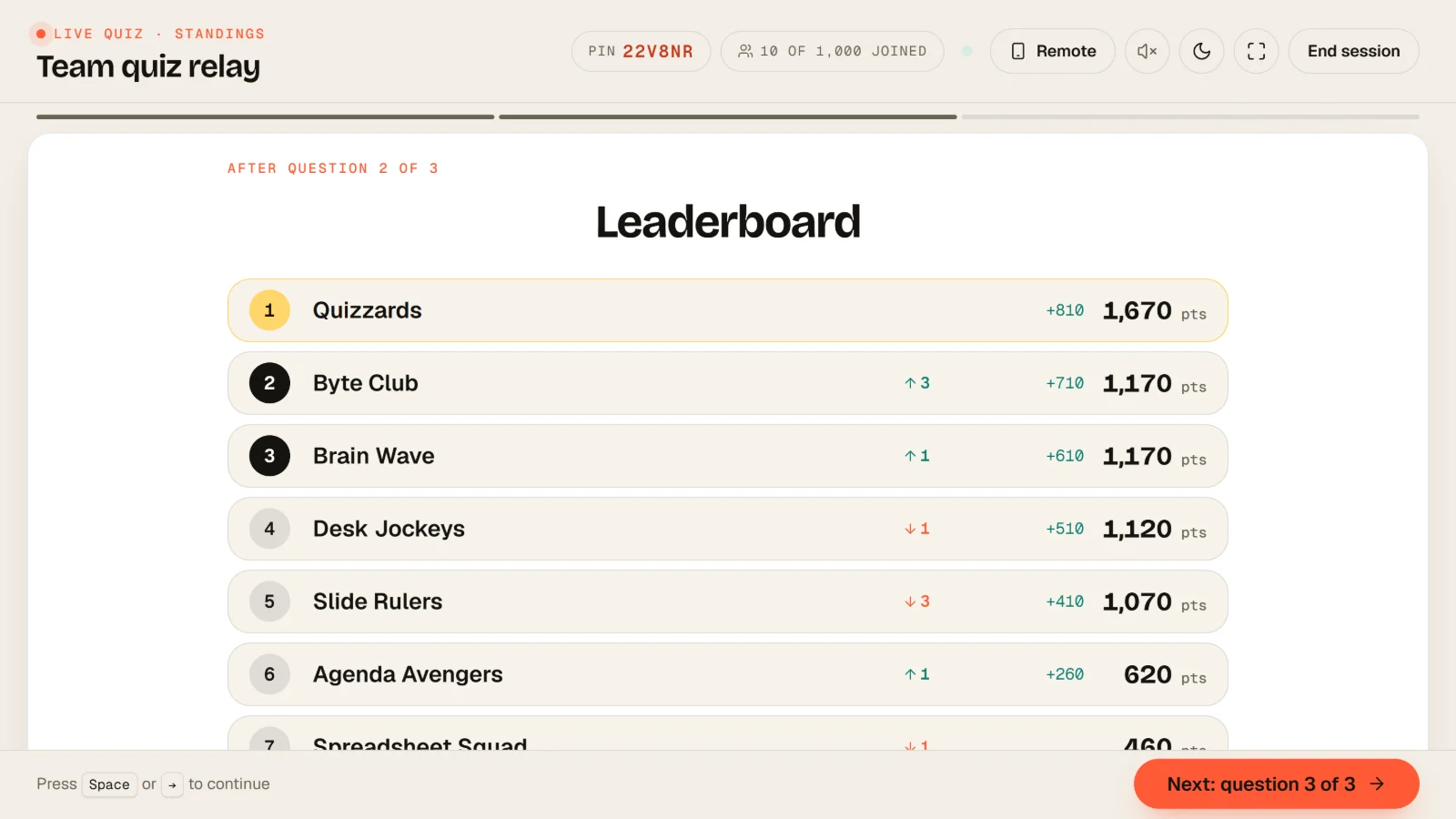
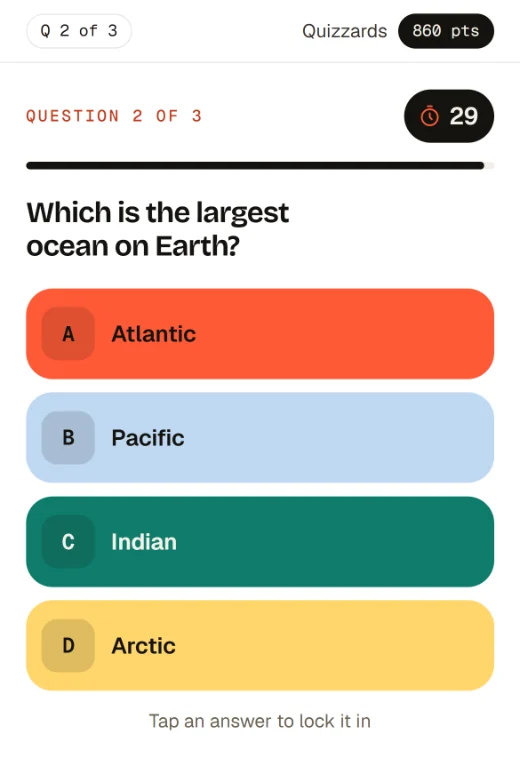
Put the leaderboard on the big screen. Each team answers on one phone, and the scores update after every question.

The RiLiFi host screen during a team quiz: the leaderboard after question 2, with Quizzards, Byte Club and Brain Wave on top
Host screen
The Quizzards team phone showing a quiz question with four answers to tap in RiLiFi
A team’s phone

How we checked these questions

We checked every answer against two sources, and at least one of them is not Wikipedia: Britannica, UNESCO, NASA, dictionaries and the organisations themselves. We left out trick wording, facts that change every year and trivia nobody could reason towards.

None of these questions repeats one on our other question pages or in our quiz templates, including the 100 on the main general knowledge quiz page.

Quizzes and interactive slides that go with this tool. Open one to see what’s inside, or use it in RiLiFi and run it live.

FAQ

Questions about these hard general knowledge questions

How hard are these general knowledge questions?
There are 50 questions: 20 medium and 30 hard, with no easy ones. They are hard but fair, so a good team can usually reason its way to the answer.
Are the answers explained?
Yes. Each answer has a short line on why it is right, and the two sources for each answer are listed under its round.
Can I play these questions live?
Yes. Open the hard general knowledge quiz template in RiLiFi, or add these questions to your own quiz. Teams join on one phone each with a PIN or QR code. The free plan covers 100 players per session.
Is there an easier version?
Yes. The main general knowledge quiz has 100 questions at mixed levels, and the easy version has 50 easy questions for warm-ups and mixed groups.
Are these questions good for college quiz clubs?
Yes, for students aged 13 and up. Use a round as practice or as a harder prelims round, and see our quiz competition guide for formats and rules.